
 FlowMic
Dictate Notion Pages From Your Phone
Dictating a Notion page from your phone means clicking a line in your page on the computer, speaking into your phone with FlowMic, and letting the finished words appear at your cursor. FlowMic is open source (AGPL-3.0) and puts your spoken words into ordinary text boxes in browsers and programs on your computer by saving your clipboard, pasting the text, and restoring your clipboard afterward.
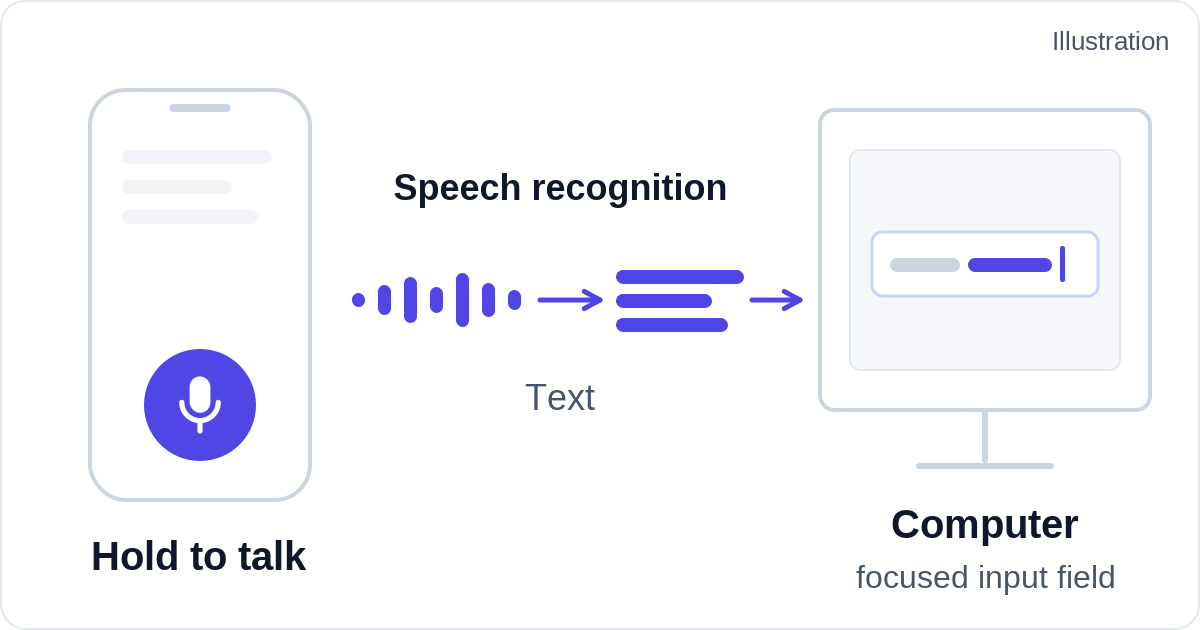
How do you set up FlowMic and dictate into a Notion page?
You set up FlowMic by installing the desktop app on your computer and the mobile app on your phone, pairing the two devices with a QR code or a 4-digit code, and clicking the line on your computer where you want your words to go. Once the cursor is in place, you press and hold "Hold to talk" on your phone, speak your sentence, and let go so the text lands at the cursor.
- Download and install the FlowMic desktop app from the download page, Microsoft Store, or GitHub Releases, and install the phone app from App Store or Google Play.
- Open the computer app, go to the devices screen, and click "Add phone" to open the window with a QR code, a 4-digit code, the "Pairing code expires in" countdown, and tabs for "Local LAN" and "Cloud relay".
- Open FlowMic on your phone, tap "Add device", and use "Scan" to point your camera at the QR code or "Enter manually" to enter the 4-digit code; for cloud pairing, you can also scan the QR code with your phone camera to use your phone browser.
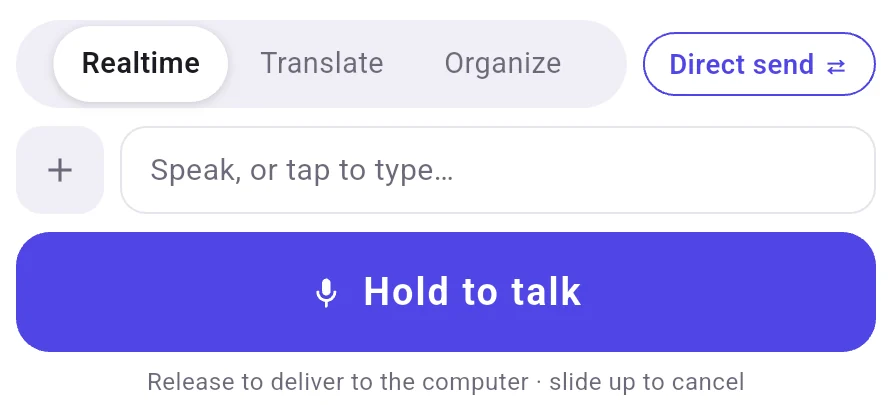
- Pick a mode on the phone conversation screen from "Realtime", "Translate", or "Organize"; start with "Realtime" if you are unsure.
- On your computer, click the line in your Notion page where you want to write so the cursor is blinking there.
- Press and hold "Hold to talk" on your phone and speak while the button reads "Release to end", keeping your finger down the whole time, or slide up to "Release to cancel" to discard.
- Release the button when you finish speaking, look over the pasted text on your computer, edit with your keyboard if needed, and continue with the next paragraph.
How do Realtime, Organize, and Translate modes handle your draft?
FlowMic gives you three modes on the phone screen: "Realtime", "Translate", and "Organize". "Realtime" stays close to your own wording in the same language, with an optional "AI polish" switch inside it for light editing. "Organize" turns rambling speech into tidy written prose in the same language with fillers and false starts removed. "Translate" listens in the language you speak and outputs only the translation in the target language you select.
Use "Realtime" when you want to stay close to your own wording, or turn on its "AI polish" switch to have a language model lightly edit the text. Switch to "Organize" when you are thinking out loud so FlowMic removes fillers and false starts; see how to speak a draft and tidy it up or brain-dumping by voice. Choose "Translate" and pick a target language under "Translate into" when you want only the translation.
Can you review and edit your words on the phone before they go to the computer?
Yes, you can switch the phone app from "Direct send" to "Manual send" whenever you want to read or edit your dictated text on the phone before it goes to your computer. With "Direct send", which is the default setting, FlowMic sends your speech to the computer as soon as you release the talk button. With "Manual send", the recognized text stays in the phone box until you send it.
On the phone screen, "Direct send" says "Speech is injected to the computer as soon as you finish", while "Manual send" says "Speech lands in the box; press ➤ to send" and holds your words on a card with "Deliver" and "Discard" buttons. In the phone conversation list, "Delivered" means the text reached the computer, while pasting it into the focused window is a second step. You can also read about saying it now and sending it to your computer later.
How do Local LAN and Cloud relay connections work?
FlowMic connects your phone and computer either over "Local LAN" when both devices share the same network or over "Cloud relay" when they are on different networks. For "Cloud relay", you sign in on the computer app first; the phone can pair without signing in, by scanning the QR code or entering the 4-digit code.
In the "Add phone" window on your computer, switch between the "Local LAN" and "Cloud relay" tabs depending on your network. Check the setup guide for connection details, review pricing and plan limits, or see how to write in Google Docs by voice.
Common questions
How do you set up FlowMic to dictate into a Notion page?
Install FlowMic on your computer and phone, click Add phone on the computer, and scan the QR code from Add device on the phone. Then click the line where you want to write on your computer, press and hold Hold to talk on your phone, speak, and release the button.
Do you need to sign in to use the cloud relay?
Yes. Over Cloud relay, used when your phone and computer are on different networks, you sign in on the computer app, and the phone can pair without signing in. Long recording on the phone also needs you to sign in.
How much does FlowMic cost?
The Free plan is $0 with 20 managed transcription minutes a month, up to 10 minutes per long recording, and 2 computers. Pro is $12 a month for 1,000 minutes and 3 computers, and Max is $28 a month for 3,000 minutes and 10 computers. All plans include all three modes, are billed monthly in US dollars, and are bought on the FlowMic website.
Which computers and phones work with FlowMic?
FlowMic runs on Windows 10/11 64-bit, macOS 11 or later on Apple silicon, and Linux x86-64 in an X11 session. On mobile, it runs on Android 7.0 or later and iPhone or iPad with iOS or iPadOS 15 or later. Install it from App Store, Google Play, Microsoft Store, or GitHub Releases.
Does FlowMic keep what you say?
FlowMic servers, including the relay, do not store your transcripts. You can read the full details on the privacy page and in the article on whether FlowMic keeps what you say.