
 FlowMic
Dictation on Windows and Mac: Which Approach Fits You
Dictation on Windows and Mac turns your spoken words into text inside the program where you are working, and FlowMic gives you an open source (AGPL-3.0) way to do this by using your phone as the microphone and placing your words at the computer cursor. You can use the built-in voice tool that comes with your operating system, or hold a talk button on your phone so your computer needs no microphone.
What dictation options do you have on Windows and Mac?
On Windows and Mac, you can either speak into your computer's own microphone using the operating system's built-in dictation tool, or speak into your phone with FlowMic so the words appear at the cursor on your computer. The two approaches do not replace each other, and you can use either one depending on where your microphone is and how you like to work.
Windows includes built-in voice typing, where you sit in front of the PC and speak into the computer's own microphone. macOS includes built-in Dictation, which also uses the Mac's own microphone while you sit at the computer and talk.
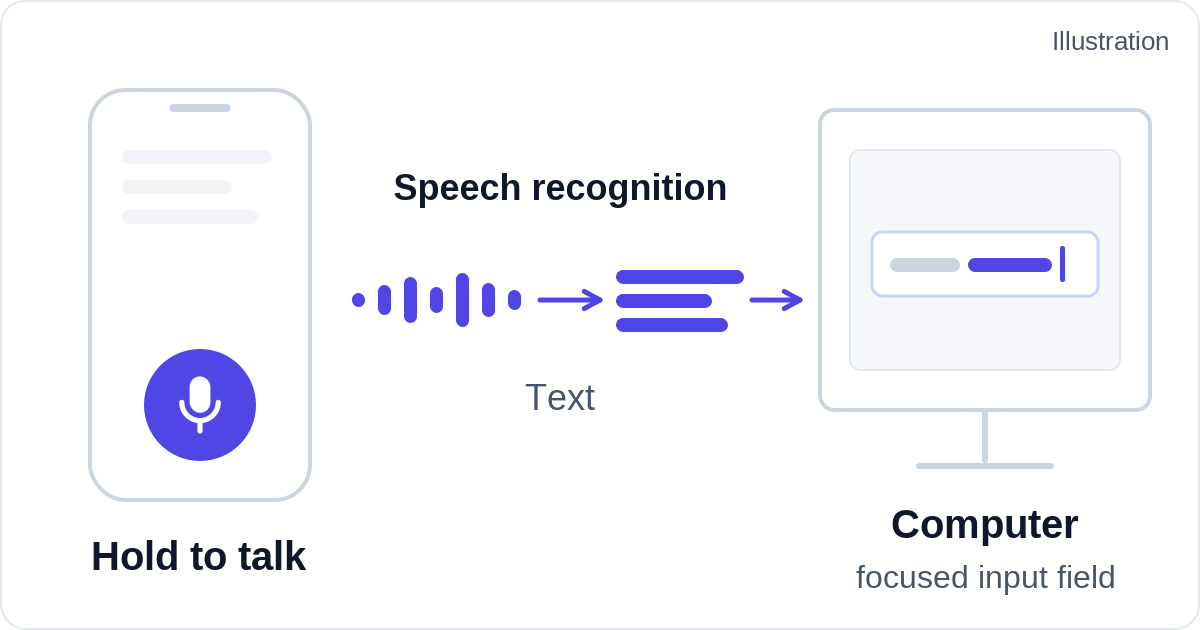
FlowMic puts the microphone and the talk button on your phone. You hold a button on the phone screen, talk, and let go, and the finished words appear in ordinary text boxes in browsers and programs on your computer. The computer app does not ask for microphone access and installs no audio driver.
When does using your phone as the microphone fit your setup?
Using your phone as the microphone fits when your desktop computer has no microphone attached, when you want to hold the microphone close or walk around while talking, or when you want the talk button on your phone screen. Your computer does not need a microphone of its own.
If your desktop has no microphone, see the no desktop microphone guide. You can also carry the phone and dictate while pacing around the room. Recording starts when you hold "Hold to talk" on the phone and stops when you release it. See push-to-talk dictation for Windows for details.
How do you set up FlowMic and dictate your first sentence?
To start dictating with FlowMic, you install the app on your computer and your phone, pair them by scanning a QR code on the computer screen, click inside a text box on the computer, and hold the "Hold to talk" button on your phone while you speak. When you release the button, your words appear at the cursor on your computer.
- Go to the FlowMic download page and install the desktop app. On Windows 10/11 64-bit, use the Microsoft Store, MSI, or portable zip from GitHub Releases. On macOS 11 or later on Apple silicon, move FlowMic into "Applications" before first opening it and grant Accessibility permission. On Linux x86-64 in an X11 session, install the .deb or portable zip.
- Install FlowMic on your phone from Google Play (or the GitHub Releases APK) on Android 7.0 or later, or from the App Store on iOS or iPadOS 15 or later.
- On your computer, open "Devices" and click "Add phone". A dialog shows a QR code, a 9-digit PCID, a 4-digit pairing code, and "Pairing code expires in". The code lasts 5 minutes and refreshes by itself.
- On your phone, tap "Add device", stay on "Scan", and point the camera at the QR code without pressing a button, or use "Enter manually".
- Click inside an ordinary text box in a browser or program on your computer. On the phone, press and hold "Hold to talk" and grant microphone permission on first use. The label becomes "Release to end". Speak and let go when done, or slide up to "Release to cancel" and let go to discard.
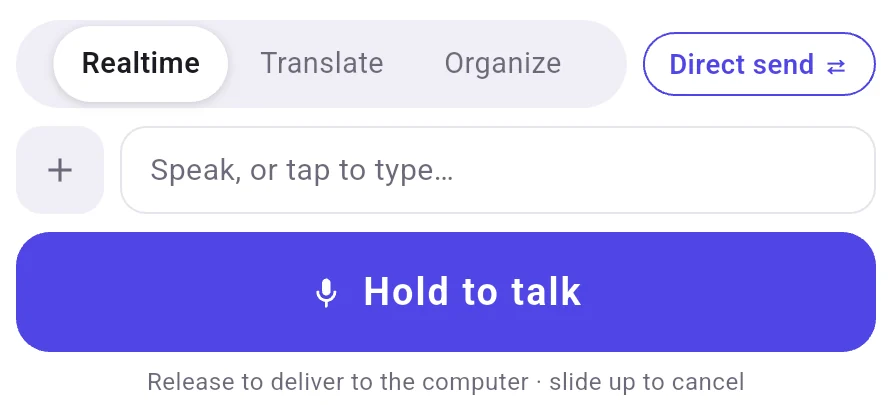
- On the phone, the item shows "Delivered", meaning the words reached the computer. On the computer, the words appear at your cursor. Look over the words and send them the way you normally do.

How do the three speaking modes and plans work?
FlowMic gives you three speaking modes on the phone screen: "Realtime", "Translate", and "Organize". Each recording runs through the single mode you selected before speaking, and all three modes are included in every plan. FlowMic servers, including the relay, do not store your transcripts.
- "Realtime" outputs the recognized words in the language you spoke. Its "AI polish" switch (Strict or Smooth), when on, has a language model lightly edit the final text.
- "Translate" lets you speak in one language and outputs only the translation in the language chosen under "Translate into" (9 target languages, with simplified and traditional Chinese counted separately).
- "Organize" produces tidy written text in the same language with fillers and false starts removed.
For privacy details, read does FlowMic keep what you say. Plans are billed monthly in US dollars on the FlowMic website (see the pricing page): Free is $0 for 20 managed transcription minutes a month and 2 computers, Pro is $12 a month for 1,000 managed minutes and 3 computers, and Max is $28 a month for 3,000 managed minutes and 10 computers. Long recording (with sign-in) allows up to 10 minutes per recording on Free and up to 30 minutes on Pro and Max, separate from the 20 minutes a month on Free.
Common questions
What is the difference between built-in dictation on Windows and Mac and FlowMic?
Windows voice typing and Mac Dictation use the computer's own microphone while you sit at the desk and speak at the computer. FlowMic uses your phone as the microphone and puts the Hold to talk button on the phone screen, placing your finished words at the cursor on your computer without needing a computer microphone.
Can you use FlowMic if the computer has no microphone?
Yes. FlowMic does not need a microphone on the computer, does not install an audio driver, and does not ask for microphone permission on the desktop app. Your voice is recorded through the phone app, and the desktop app only needs the Accessibility permission on macOS to place words into other programs.
Where is the talk button when using FlowMic?
The talk button is on your phone screen. You press and hold Hold to talk on the phone, speak, and let go when you finish. You control recording from the phone in your hand.
What does FlowMic cost?
The Free plan costs $0 and includes 20 managed transcription minutes a month across 2 computers. Pro is $12 a month for 1,000 managed minutes across 3 computers, and Max is $28 a month for 3,000 managed minutes across 10 computers. All three plans include Realtime, Translate, and Organize, billed monthly on the FlowMic website.